
You Absolutely must not proceed without reading first Part 1 & Part 2
We walked into the hallway. It was pitch black. Sarah stopped, bewildered.
“Why is it dark?”
No electricity. We used our phone lights to find the door, and when we finally reached it, I had to heave my shoulder against the wood to get it open. Sarah’s life, bags, clothes, heavy boxes, was piled up right behind it, clogging the entrance. I forced my way through the narrow gap.
I felt like I had stepped into an icebox. More than the cold, what I beheld was chaos.
Clearly, the cleaning woman hadn’t set foot in the place. A mop sat in a bucket in the middle of the floor, the water murky and stagnant. Dog hair was everywhere, clinging to the floors, the furniture, the cushions. The balcony was a wreck, cluttered with dead leaves. The plants hadn’t been watered in months. Slippers lay in random places. Dust. Grime. And the smells.
Sarah was gutted. Her embarrassment was so thick I could feel it pressing against my skin. She kept apologizing over and over.
“I’ll go to the electricity company,” she said. “I’ll get it back on. I’m so sorry. I’m so, so sorry.”
And then she was gone. I stood there in the cold, looking around in the dim glow of my phone. The house was stalled. In the kitchen, I opened the fridge and the heavy, stale scent of forgotten leftovers hit me. I pulled open a drawer and found plates with the dried-up remains of old meals still stuck to them, put away as if they were clean. Utensils were piled in the tray, tacky with a layer of old grease.
The neglect was everywhere. The coffee machine still held a filter of old grounds, furred with a layer of grey mold. In the bathroom, a ring of rust had started to bite into the toilet seat, and the shower walls were dull with a stubborn, soapy film.
I wanted to cry. I’d been expecting something beautiful. A home. Instead, I was standing in a cold, dark, filthy disaster. There was a moment where I went down the rabbit hole and wondered if my prayers had gone unanswered, if God had even listened.
But I caught myself. Good things don’t always start good. Wait. Be patient. Let the story unfold. I started looking closer. The mattress was new. The cushions and pillows were clean. The covers fresh. That mattered. You rarely find that, no matter the price.
The electricity came back an hour later. The lights flickered, hummed, and then surged, revealing the house in a sudden, sharp clarity.
It was grand.
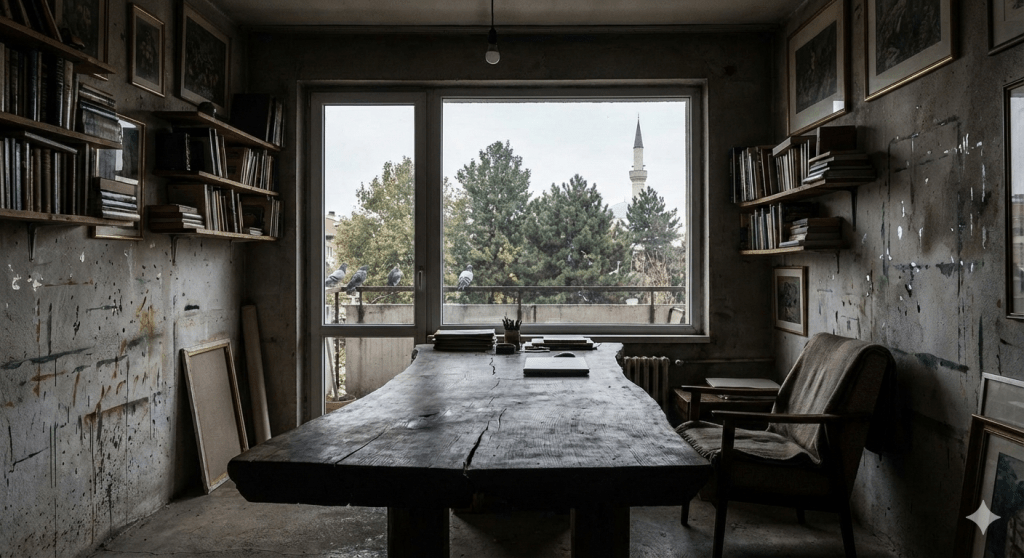
Not in the sanitized, Instagram-ready way. It was gorgeous in the way only a real artist’s house can be. The walls were painted by hand, Sarah’s hands. Raw concrete, sometimes exposing steel or piping. The floors were concrete too, smooth but still rough in places. Paint splatters were everywhere—on the floors, the walls. Places where she’d started painting and never finished. Random brush strokes. Textures. Layers. Beautiful chaos.
Her original paintings hung on the walls. Books were sprawled everywhere, on shelves, on the floor, stacked in random piles. They existed the way books exist in a house where someone actually reads them. The furniture was a collection of the vintage, the exotic, the handmade. Not one piece matched the other, yet together they formed a tapestry of color and shape.
And then, there was the desk.
It sat against a window so large the far wall gave way to a living canvas of rustling trees and passing birds. A single, colossal slab of ancient, dark wood stretched the full width of the glass. The surface was a deep, resonant brown, streaked with warm, golden-red hues, a history of deep lines and heavy-handed craftsmanship. The texture was raw, an honest touch of nature only lightly polished. Scattered across the wood were smooth stones, weathered shells, and silver trinkets from years of travel, catching the light like liquid gold.
Looking at it, I felt it. This was the place where the work would happen. This is where I would write my next book.
The guest room was a minimalist, Japanese-style space. The walls were a masterpiece, painted by Sarah’s hand with more care and intricacy than anywhere else in the house. It was a room of low lines and soft light, with a simple mattress on the floor, exactly how I like to sleep. Small, low tables made the air feel open. Plants were everywhere, in all shapes and sizes. This room opened onto a small balcony where the trees were close enough to touch. I smiled at the pigeons and sparrows with their fearful, tilted heads. This frantic, fluttering community would be my companions.
Then Sarah came back.
She stood in the middle of the room and just froze. With the lights on, the mess was inescapable. The dead heater felt like a final blow. She tried her cleaning lady again, but no one picked up. She looked at me, waiting for the argument to start, expecting me to ask for my money back. She didn’t know me yet.
There is no “nice” in a crisis. I just needed to be human. I took her hands; they were shaking.
“Look at me,” I said. “I’ll be okay. We will manage. Do you have a small heater?”
She nodded.
“I’ll take care of the house,” I told her. “I’ll clean it. I’ll get settled. Go finish moving out of your studio. Go home, take a shower, and go pick up your Master from the airport. Take a few days. When you’re done, we’ll fix everything together.”
She looked at me like I was speaking a language she’d forgotten. I made her a cup of coffee to steady her, then led her to the door. “Just go,” I said.
When the door clicked shut, I was alone. I knew right then: I wasn’t going anywhere. It was a decision I never questioned again.
I went to the store and bought every cleaning tool imaginable. I was already paying a high price for the stay, and now I was spending even more. I came back and began to scrub. I went over every inch of that house until the air itself felt different. The weird thing was, I felt no repulsion. I was actually peaceful; it was like a natural movement of reclaiming my own home. When I was finished, the house was brilliantly, squeaky clean.
Now that the space was finally visible, I started shifting the furniture. Exploring the cupboards and storage, I found striking pieces that had been tucked away. I brought them all out.
I began to arrange everything. I wanted to move—to dance through the rooms, sway around the kitchen while I cooked. I was building a sanctuary for my own rhythm. In front of every window and balcony, I placed a comfortable chair. That was my priority. Every morning and every night, I would sit for an hour or more, looking at the skyline, praying and singing praises to God.
I sat there, finally, sipping a cup of coffee and admiring what I had done. I was grateful. I thought: finally, I can rest.
But the universe told me: Not so fast.
To be continued ….


Leave a Reply