
Or why “Biohackers” are getting richer as you get sicker
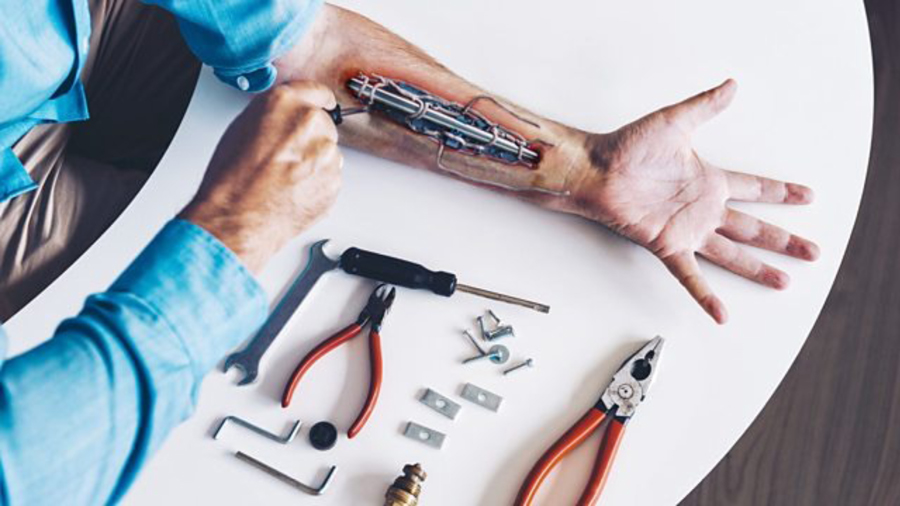
At some point in the last decade, without anyone formally announcing it, we handed over the keys to the most sophisticated biological instrument ever produced: The Human Body, and gave them to a smartphone.
We did it willingly. Enthusiastically, even. We strapped sensors to our wrists to tell us how we slept. We watched graphs to tell us whether we were stressed. We logged every calorie, every step, every heartbeat into apps that promised, in return, to tell us who we were physiologically speaking and what we needed to do about it.
We called this progress. We called it “taking control of our health.”
It may be worth asking what we gave up in the exchange.
For most of human history, the body managed its own accounting. You didn’t need a step counter because your thyroid and adrenal glands were already managing your energy flux in real time, calibrating output against intake with a precision no algorithm has yet replicated. You didn’t need a sleep tracker telling you whether last night was “restorative” because your own nervous system was reporting that information directly, in the form of how you felt when you opened your eyes.
The body has a language for all of this. It has been fluent in that language for hundreds of thousands of years.
The question is whether we still know how to listen.
The evidence suggests we don’t. Not because the body has stopped speaking, but because we have become so accustomed to reading the translation that we’ve forgotten the original. We look at a watch to determine if we are recovered instead of feeling the quality of our own connective tissue. We look at a glucose monitor to determine if we are hungry instead of listening to the hormonal signal ghrelin, released from the stomach wall that evolution spent millions of years calibrating precisely for that purpose.
We have outsourced instinct. And like any skill that goes unpracticed, it atrophies.
The industry that enabled this trade is now, by any measure, an extraordinary commercial success. The global wellness economy reached $6.8 trillion in 2024 nearly four times the size of the entire pharmaceutical industry. It is growing faster than global GDP and is projected to approach $10 trillion by the end of the decade. The wearable device market alone generated tens of billions annually, on the back of a promise: that more data means better health.
But there is a gap between that promise and what the science actually shows.
A systematic review of 65 studies on wrist-worn fitness trackers found that while step counts were reasonably accurate, no device tested came within acceptable margins for measuring energy expenditure with error rates exceeding 30% across all brands. Sleep tracking fared similarly: the algorithms that assign you a “sleep score” each morning are largely inferential, extrapolating from movement and heart rate data rather than measuring the thing they claim to measure. A 2018 review of consumer wearable technologies found that only 5% had been formally validated against clinical standards.
This is the device you are consulting instead of your own body.
The psychological consequences of this swap are only beginning to come into focus, and they are not comfortable reading.
Research published in BJPsych Open documented eight categories of harm emerging from diet and fitness app use, including fixation on numbers, rigid dietary thinking, obsessive logging, and app dependency users who became so reliant on the interface that they experienced anxiety when they couldn’t access it, and redownloaded the app specifically to relieve that anxiety. A separate study of 1,357 adults found that prior calorie-tracking app users showed significantly higher rates of disordered eating than non-users.
A Duke University study found something subtler but perhaps more revealing: that tracking an activity, measuring it, quantifying it actively diminishes the enjoyment of that activity. The act of observation changes the thing observed. Or in this case, the act of measurement changes how the person experiences the thing being measured.
We set out to optimize our walks. We made them less enjoyable in the process.
There is a word relatively new, increasingly relevant for the condition at the far end of this spectrum: orthorexia. An obsessive preoccupation with eating correctly, characterized by rigid rules, social withdrawal, and anxiety that scales in proportion to the perceived precision of the dietary system being followed. The wellness industry, with its protocols and trackers and scoring systems, has not caused orthorexia. But it has created an environment in which the traits that precede it, the rule-following, the number-watching, the fear of deviation, are indistinguishable from virtue.
Then there is the layer of the wellness economy that operates furthest from the body entirely: biohacking. Nootropics stacked in the morning. Cold plunges at dawn. Peptide injections sourced from corners of the internet that do not invite scrutiny. Red light panels. IV drips administered in wellness centers. Each intervention designed to “optimize” some measurable output: cognitive performance, hormonal profile, cellular recovery by overriding the system’s defaults with a targeted chemical or thermal stimulus.
The logic is seductive, and it borrows the vocabulary of engineering: if the body is a system with measurable parameters, then isolated interventions should produce predictable improvements.
But the body is not that kind of system. It is not a collection of independent levers that can be adjusted one at a time. It is a network of tightly coupled feedback loops, where a change in one variable cascades through dozens of others in ways that are often invisible until they become symptomatic. When you suppress cortisol with an adaptogen, you affect the adrenal axis. When you force sleep architecture with a sedative, you alter the hormonal cascade that depends on it. When you flood the system with isolated, high-dose nutrients, you trigger compensatory downregulation —the body reading the synthetic abundance as a signal of dysfunction and adjusting its own machinery accordingly.
Every biohack, in this sense, is a loan taken against future systemic integrity. The bill is often deferred long enough that we don’t connect it to the borrowing.
What’s striking about this entire apparatus, the trackers, the apps, the stacks, the protocols is not that it is unscientific. Some of it is grounded in real research. What’s striking is that it has generated, for all its sophistication, a population that is more anxious about its health, more dependent on external validation, and by many measures more unwell than the generations that preceded it. A $6.8 trillion industry built on the premise that the body is failing has not produced a population that is thriving. It has produced one that is monitoring.
There is a difference.
The body has not changed. That is the thing worth sitting with. The same neuro-hormonal signaling system that managed energy, sleep, hunger, and recovery for hundreds of thousands of years is still running right now, in you largely without your conscious participation and certainly without your Oura ring’s input.
It knows things your wearable cannot measure. It integrates information from every organ, every tissue, every nerve ending simultaneously, and translates that integration into a felt sense of state tired, energized, hungry, satisfied, off, right that is, when we bother to listen to it, extraordinarily reliable.
The problem is not that this signal is weak. The problem is that we have spent a decade generating so much noise that we can no longer hear it clearly.
Quieting that noise is not a protocol. It doesn’t require a device. It requires something considerably more countercultural in the current moment: the willingness to put the phone down, to sit with your own physiology for long enough to remember that it was speaking to you long before anyone invented an app to translate.
You are not a dashboard. You are not a set of metrics awaiting optimization.
You are a biological system of extraordinary sophistication, and it has been trying to tell you what it needs for a very long time.
The question is whether you are still listening.

Leave a comment