The sun blazes mercilessly as beads of sweat trickle down Temur’s collar, his old bucket hat offering little reprieve. He tosses hay for Syurpriz. The twenty-two-year-old white Orlov he has rescued and nurtured over twelve years seems blissfully unaware of the toil surrounding him.
“Think about it, Lana,” Temur says, as he takes a moment. “You carry the DNA of exile: your father crossed borders on foot to escape occupation; your mother comes from a lineage scattered by imperial violence. You’ve inherited not just their genes, but their existential homelessness.” Temur is Ossetian, born and raised in Georgia yet foreign in both countries. Despite owning this land, he remains unable to secure permanent status in Georgia.
At forty-two, Temur is married to Vera, a thirty-seven-year-old Muscovite. They are my gracious hosts in this charming farmhouse they share with three mischievous dogs: Khristofor, Beba, and Aiwa, plus a menagerie of hens and pigs.
I leave Temur to broil and enter the kitchen, where Vera prepares Satsivi, that quintessential Georgian dish usually reserved for celebrations. Chicken swims in a rich, creamy sauce made from ground walnuts, garlic, and a symphony of spices including blue fenugreek and marigold.
As I take over stirring the sauce, a grueling business requiring vigilance to prevent burning, Vera sinks into a chair, sighing as she pours herself ice-cold water.
“I am Russian to the bone, yet I never truly felt I belonged there.” She looks directly at me. “Look at us, we come from different worlds, yet it’s as if we’d known each other forever. No bridges to cross, no walls to tear down. I can’t find that with people here.”
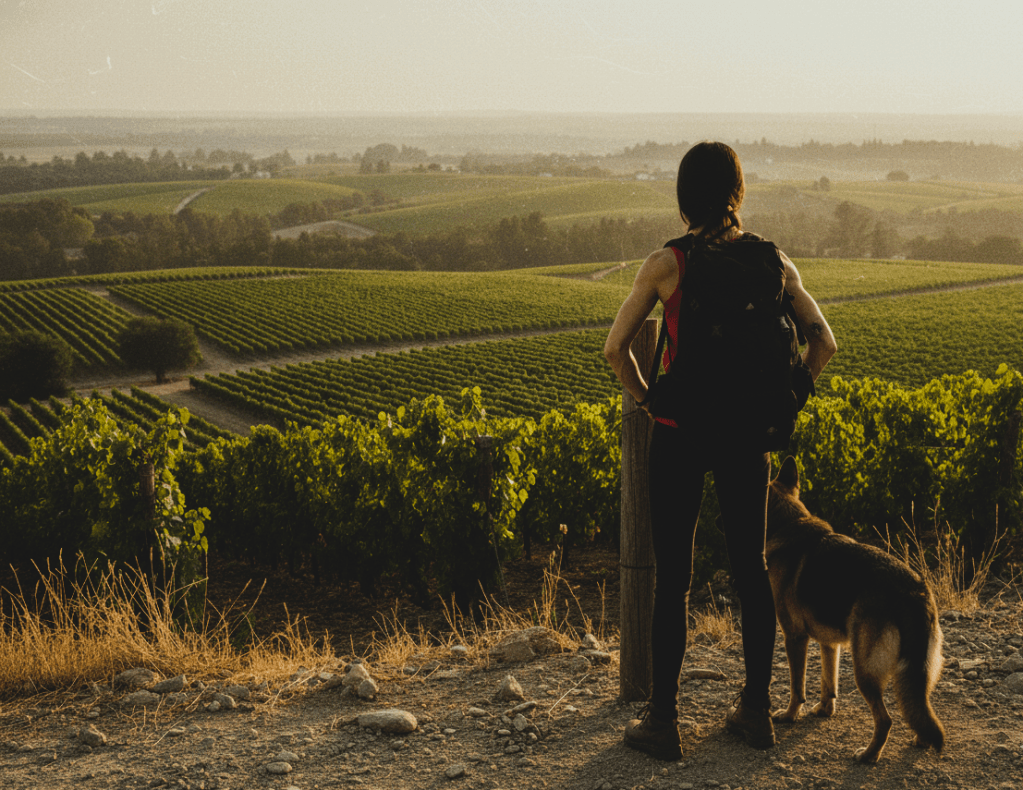
Through the window, vineyards stretch across Georgia’s wine country. “It’s the story of my life,” I say. We sit in comfortable silence, only the rhythmic stirring and soft rustle of wind between us.
Vera, as if speaking to herself, muses: “He loves it here, of course. Men have no trouble finding common ground. They can transcend differences, discussing land or business without concern for what anyone wears or how clean their homes are. Women are different.”
“I can picture you both in Canada,” I suggest. “You’d fit perfectly.”
Vera’s smile flickers with longing. “Maybe one day. For now, I have Syurpriz to take care of.”
“I know what you mean. I couldn’t leave Jordan until Max passed away. He was too old for change. The moment he died, nothing was left for me there. Within days, I sold everything and left.”
Patting the chicken with oil-blotted cheesecloth, Vera hands me ice water. I feel sweat running down my back. “But you’re not actually Jordanian, are you?”
“Passports are destiny, aren’t they,’ I say with a bitter smile. ‘In Jordan, you’re not truly Jordanian unless you descend from original tribes. Your family name always gives you away”
“No wonder you feel out of place. I’ve faced challenges here, and I’ve only been in Georgia three years. As a Russian, I understand why I may not always be welcomed. But to be born and raised somewhere and still seen as an outsider?”
“With life’s uncertainties, it grounds me to know I’m Slavic through and through,” Vera smiles, picking figs from the fridge. “From our orchard.”
The Weight of Identity
“When someone asks where I’m from, it’s always complicated. For most, it’s a simple answer. For me, it’s a narrative that unfolds over pages.”
I accept the fig gratefully. “When you travel, you realize how deeply ingrained prejudice can be.” I shift my body to look directly at Vera, “In the beginning, I felt it was my duty to show pride in my heritage. Now, I find it’s just not worth the effort.” I shrug, “I just don’t care anymore. I give whatever answer keeps their alarm bells quiet. Let them revel in their ignorant prejudice.”
“‘I hide that I’m Russian all the time,’ Vera says, louder than expected.”
“You want prejudice?” I ask, offering a mischievous smile.
“My father is Palestinian; he fled Israeli persecution. After making his way to the UK and then the US for a civil engineering degree, he ended up in Jordan. There, he met my mother- a Circassian whose family had fled Russian ethnic cleansing.
Circassians don’t marry outside their community. Because of this, my grandparents boycotted the wedding.
But here’s the irony: I was raised in that same house. My grandmother became the closest thing I had to a mother.
I was raised fully Circassian, with their motto ringing in my ears: ‘If my finger were Arab, I would sever it.’ That motto made me an outsider in my father’s horribly elitist family, who simply looked down on the ‘barbarians’ from the Caucasus.”
“Your family makes the ethnic conflicts in Georgia seem like child’s play,” Vera chuckles.
“Imagine explaining all that to someone who just asked ‘Where are you from?’ out of habit,” I chuckle back.
Vera takes a few moments to stop laughing.
“You don’t appear Arab, though. We Russians have a look that always gives us away,” Vera says with an eye-roll. I smile with agreement.
“You’re done here, young lady.” Vera grabs the spoon, smoothly taking over the stirring. “It’s almost done anyway. Rest for a bit.”
“I resemble my mother’s family; their genes run through me. I don’t look Jordanian, my entire life people just assume I’m foreign. I look nothing like my sisters, either, and they ensure I’m reminded of that.’ I offer a dry laugh.
Vera’s expression hardens. ‘Not very kind,’ she states flatly.
‘It’s not just how I look. It’s who I am. Independent. My own person. A nomad, who refuses to need anyone. The gap grows wider every year, the more I become myself, the less they can stand having me around. In Jordan, I’m a stranger to country and to blood.
Freedom and Departure
“Practically everywhere I go, people assume I’m foreign. I gave up on belonging a long time ago.”
Vera sets down her glass and locks eyes with me. “For you, it’s not just about belonging. Perhaps it’s about the freedom to choose. Your nomadism is a conscious decision.”
The air thins around me. I listen, saying nothing, but my energy encourages her to continue.
“You’re incredibly sociable,” she pauses, studying my face with careful precision. “It doesn’t take a genius to recognize your outsiderness, that world of your own where you retreat.”
She waits. “Your nomadism honors both your inherited restlessness and your capacity for connection without commitment.”
I look away momentarily, absorbing words that resonate deeply yet require excavation.
“‘Freedom,’ I say, my voice faltering. ‘I’ve always yearned for it, but not the kind people speak of. Ever since I was a kid, gazing at horizons that stretch infinitely. It’s like watching a ship sail further and further until it disappears into the vastness. That’s where I’ve always wanted to go.’”
Vera tries to mask her discomfort. I smile, wondering if I’ve revealed too much. “But where? Do you even know?” she asks softly.
“‘I don’t know where, but it certainly is a place. I live it though—this freedom, this lightness of being—when I’m moving, unanchored by ties or plans.’”
What I don’t share is this: I am addicted to departure. I crave these very moments, right here in her kitchen, stirring sauce, the joy of knowing and being known. Yet to savor them, I need the reassurance of a door, a ship on the horizon, a means to leave. Otherwise, these connections become a noose.
Because I don’t truly believe good things last. I’ve watched love turn into hurt and betrayal. Blood into poison. Every beautiful thing I’ve known has eventually turned ugly. So I leave first. Before the sweetness curdles. It’s best to have nothing to lose, nothing to fear. Then I can relish these precious moments and depart with them still intact.
Vera searches my face, trying to decipher the thoughts swirling within. She raises her eyebrows, takes a deep breath, and gestures for me to sit back as I stand to help set the table. She arranges the chicken in a beautifully ornate dish. “My grandmother’s,” she says, pouring sauce and carefully setting the table with plates, forks, knives, spoons, glasses, napkins, flowers, water jug—a tableau of beauty in this lovely home filled with beautiful souls.
The celebration:
Vera’s head shoots up, a sudden radiant smile erasing all traces of exhaustion.
Temur bursts in, a huge figure with the biggest grin on earth. In one hand, he holds the wine; in the other, three glasses dangle between his fingers. He looks at me:
“Ahlan! You’ve stepped into my marani here in Kakheti, and I’m honored to pour for you. To serve our Saperavi is an art, not just a task.”
His voice carries centuries of ritual, of belonging rooted deeply in soil and vine. He speaks of breathing, temperature, the art of serving Saperavi – not just wine, but heritage itself.
He pours with ceremonial precision. I watch this man who cannot fully belong here either, yet has found a way to pour himself into the rituals of place. The wine is dark, complex, notes of blackberry and earth – a taste that knows its terroir intimately.
‘We toast not just to wine, but to life itself. Gaumarjos!‘”
For a moment, surrounded by the scent of walnut sauce and the warmth of people who’ve claimed me, I almost understand what it means to belong.
Almost. But even as I savor it, I feel that familiar stirring, the restless pull toward the door, toward whatever ship waits beyond these vineyards. The freedom I’ve chosen tastes exactly like this: bittersweet, ephemeral, and entirely my own.

Leave a comment