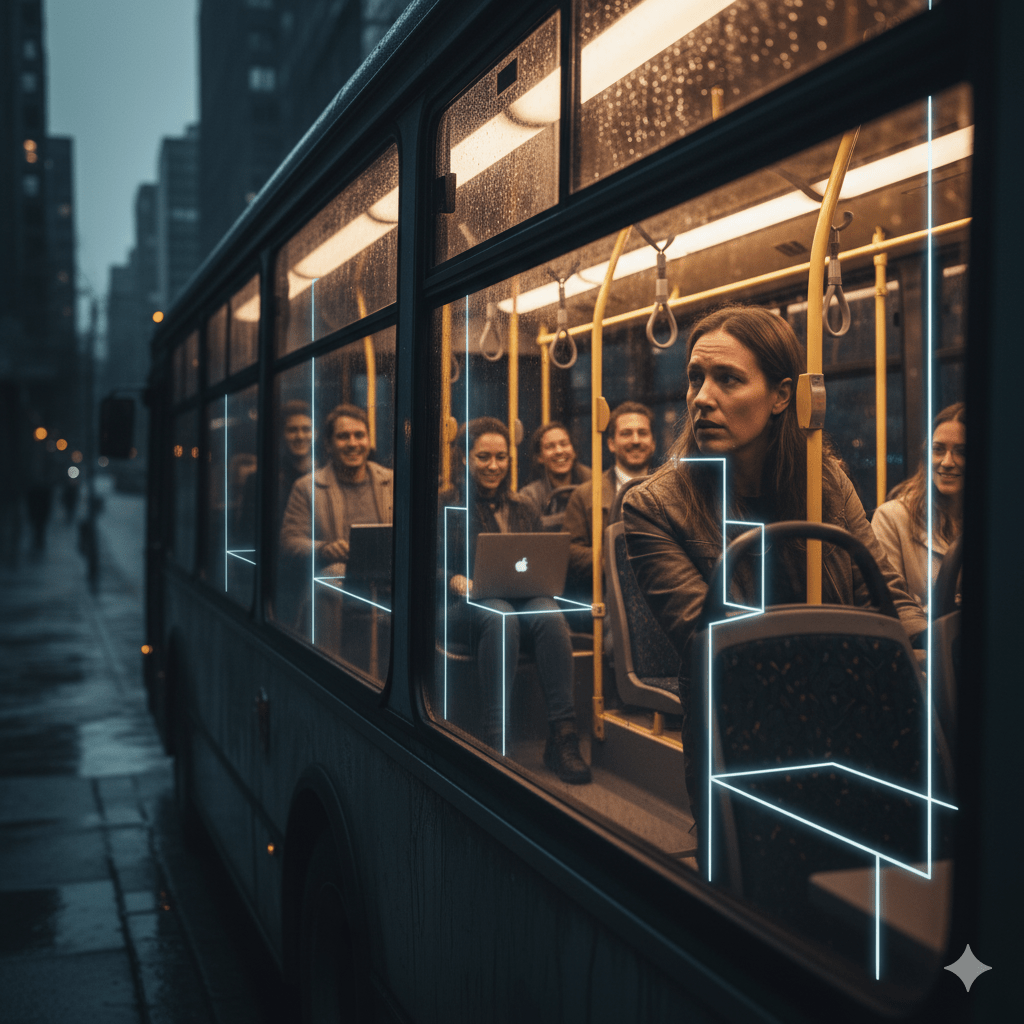
The bus lurched forward, packed tight. Eight men got in – blue collar, shabby, work-worn. I’ve learned to recognise economic desperation. I’ve watched power sort human worth my entire life.
When one sat beside me and called to his friend in Egyptian Arabic, I interrupted their conversation. My rusty Egyptian kicked in, and a brief chat ensued about work, about temporary survival in a foreign place.
They got off at their stop, fumbling for change. The moment their feet hit the pavement, the driver spat. Passengers sneered. Someone muttered ‘Suriye’ (Syrians) like a curse.
This is how the invisible architecture of power operates– not through grand declarations, but through the everyday geometry of who belongs and who doesn’t.
The Architecture Revealed
You know what privilege actually is? It’s architecture. This blueprint is running your life, whether you see it or not.
I was simultaneously the privileged observer and the marginalized body in that space. Half-Arab, visibly fit, Western-educated, economically comfortable – my appearance grants me access those workers will never have. But I know what waits if I reveal too much. The moment I say ‘Jordanian,’ doors close. The moment they hear Arabic, the welcome evaporates.
This is the paradox that destroys simple narratives about oppression: we are all simultaneously privileged and marginalized, depending on which blueprint you’re reading from. The white, male, Western friend who couldn’t understand the discrimination I encountered daily in Turkey wasn’t evil – he was structurally incapable of seeing what his position shielded him from.
Those bus passengers weren’t inherently cruel. It’s the ugly mathematics of survival: someone has to be at the bottom, and thank God it’s not me.
The Blueprint’s Defence System
What we witnessed on that bus was the architecture defending itself. When the privileged encounter evidence of inequality, they don’t just dismiss it; they actively attack it as a threat to their worldview. Because seeing privilege clearly would collapse the comfortable fiction that their corner office came through merit rather than inheritance.
The architecture is maintained by millions of daily interactions where people unconsciously reinforce the very systems that oppress them.
The Mathematics of Invisible Advantage
Every privilege operates on a zero-sum equation that nobody wants to acknowledge:
Your safety = Someone else’s vulnerability Your comfort = Someone else’s discomfort Your easy access = Someone else’s locked door
Let’s do the math on my morning coffee ritual. I sit in a café, claiming space that my various privileges make accessible. The barista – likely an economics student working three jobs – serves me with practiced deference (because that’s how the math works when you need tips to pay rent). The neighborhood itself exists because other neighborhoods absorbed the poverty, the crime, the infrastructure neglect.
Every parking spot in the nice neighborhood = One less in the struggling one. Every private school scholarship = Public funding that goes elsewhere. Every safe walking route = Danger pushed to someone else’s street. The math is always exactly this cruel.
My comfort isn’t just my comfort. It’s a mathematical relationship where my advantages require others’ disadvantages to function. The architecture literally depends on this imbalance – remove it, and the whole structure collapses.
The Price of Seeing
Once you see the invisible architecture, you can’t unsee it. Every interaction becomes a lesson in structural design. Every comfortable space reveals its exclusions. Every advantage you’ve never questioned becomes visible in the blueprint.
Most people resist this recognition with everything they have. Not because they’re evil, but because seeing clearly requires dismantling the comfortable fictions that make daily life bearable.
Real strength comes from facing uncomfortable truths rather than avoiding them. From recognizing that our humanity isn’t diminished by acknowledging our advantages; it’s enhanced by it.
The Radical Act
The bus keeps moving. The architecture keeps sorting human worth with mechanical precision. But once you see the blueprint, you can begin to imagine different designs.
The most radical act isn’t climbing higher in the existing structure – it’s looking at the blueprint and asking: What were we thinking?
Because someone has to be at the bottom. But maybe – just maybe – we can stop pretending it’s natural that it’s never us.

Leave a comment